Nicholas TongNetgear Nighthawk RAX80
30 / 46
the end of support list
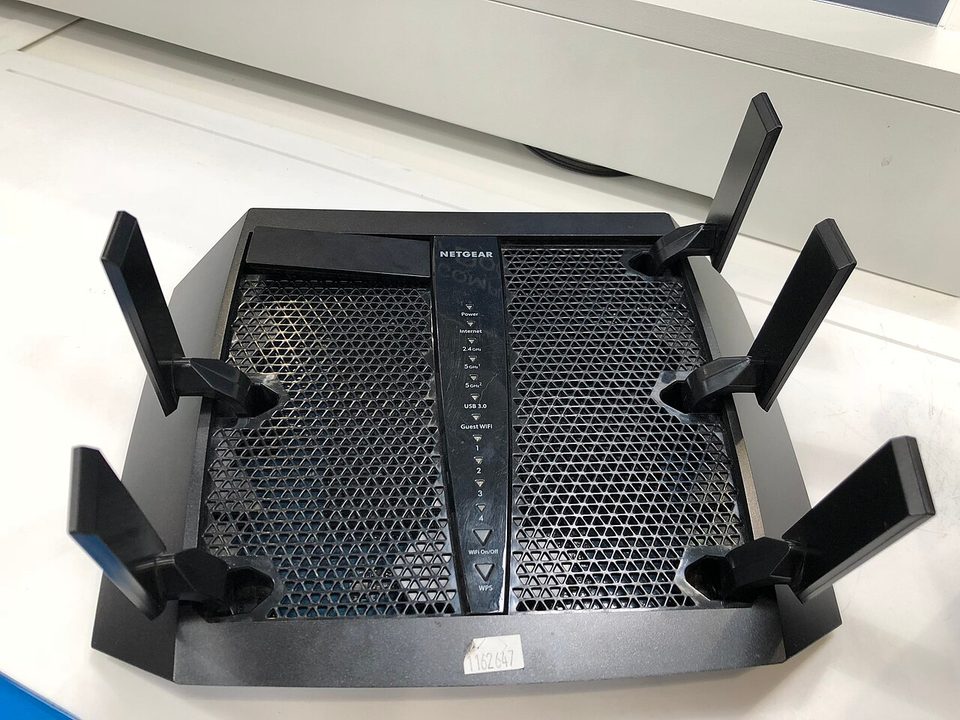
In April 2021, Netgear published a list of routers it was not going to patch anymore, and a friend called me that week because his model was on it. He had bought that router on my recommendation two years earlier. I remember the call because I was standing in my kitchen looking at my own Netgear purchase history while he talked, doing the math on how long his four hours of migration would have bought me. The router I am reviewing here, the Nighthawk RAX80, was not on that list. It will be on one eventually. That is not a prediction, that is the lifecycle, and nobody puts it on the box.
The RAX80 is Netgear's Nighthawk AX8, a Wi-Fi 6 router from 2019 with a pair of fold-open wings, four antennas inside those wings, and a quad-core Broadcom doing the routing. Tom's Guide reviewed it in February 2021 and found what everyone finds: excellent 5GHz performance, a design that looks like a Batman toy, and Netgear Armor, the Bitdefender-powered security suite, included for a year and $45 a year after that. It carried a near-$400 flagship price at launch and was already in the low $300s by the time that review ran. Mine came secondhand, and I will say it once: this is not a purchase recommendation. I paid for it myself, and I bought it to study exactly the question this post is about.
the part everyone gets wrong
People buy flagship routers like they buy phones, on the assumption that the vendor will keep them updated for a reasonable life. Phones get five years of patches now. Routers get whatever the vendor feels like, and the April 2021 list is what the end of that feeling looks like: dozens of models, some only four or five years old, with known vulnerabilities and no fix coming. The vendor's position is technically defensible. The devices shipped their support window. The owner's position is simpler: the $300 always-on box on the edge of the network now has a shelf life the vendor chose and the buyer did not know about.
The second thing people get wrong is the security suite. Armor is real protection, a Bitdefender feed plus client apps, and Tom's Guide is right that it works. It is also a subscription that starts when the router is new and shiny, and the mental model it builds is "my router is secure, I bought the thing that does security." The patch is the security. The suite is a seatbelt on a car whose brakes the manufacturer can stop servicing.
the mechanics
The RAX80's bones are good, and that is the frustrating part. Wi-Fi 6, AX6000 class, which splits into 1.2Gbps on 2.4GHz and 4.8Gbps on 5GHz, four antennas in the wings, four gigabit LAN ports, two USB 3.0 ports, and a CPU that handles my gigabit line with Suricata-style inspection running on a separate box without breathing hard. WPA3 arrived in firmware. The 5GHz radio, at close and middle range, is still competitive with routers released years later, and Tom's Guide's testing agrees with mine.
The software is where the era shows. The Nighthawk app is the primary interface now, and it wants a Netgear account, and remote management runs through Netgear's cloud. Armor sits on top with its feed and its apps. None of this is evil. All of it is upstream, and in April 2021 the upstream proved that it can end. The router itself has no dependency on Armor; turn it off and the box routes fine. The dependency that matters is firmware, and firmware is the one thing on this box you cannot self-host.
where it breaks
The list. Every router ends up on one, and the interesting variable is the length of the road there. Netgear's own page now tells you whether a model is in support or not, and the RAX80 has had a longer runway than most, but the shape of the timeline is always the same: launch, flagship pricing, rapid discount, three or four years of firmware, then the model appears on an end-of-support page on a Tuesday while you are doing something else. If you have never checked whether your router is on its vendor's EOL list, this is the sentence that convinces you to do it tonight.
Then the small print of "flagship". The RAX80 has no 2.5G port, no 6GHz band, no SFP. It was the top of the line in 2019 and every one of those things shipped after. Buying the flagship buys you the fastest version of the past. The upgrade path for this box is replacement, and the vendor knows it, because the discount that got you in the door is the same discount that clears the shelf for the next one.
And a confession with specifics. I recommended that friend's router, a R6700, off a spec sheet, because in 2019 I still believed spec sheets were transferable information. The router worked for two years and then the list happened. I have a rule now: before I recommend any router, I read the vendor's end-of-support page first. It takes four minutes. It would have taken zero minutes in 2019 and I would have recommended something else.
what to do
- Tonight, look up your router's model on the vendor's support site and find out whether it is in support, EOL, or neither-and-forgotten. Write the date down.
- If your router is on an EOL list, replace it. Not eventually. A router with known vulnerabilities and no patch is not a router, it is a listening device you paid for.
- When you buy the next one, check the end-of-support policy before the spec sheet. Support length is a spec.
- Turn the security suite off if you already run filtering, and put the money in a box fund instead. Five dollars a month becomes the next router.
- Auto-update if the vendor offers it. Netgear's app does it reluctantly; make it less reluctant.
The RAX80 deserves a better story than the one its category gives it. It is a good router, and it is a good router on a timer nobody disclosed, and the timer is the review.
Check the list tonight. If your model is on it, the replacement is the only item on the shopping list that matters this month.