Jason LeeHappy Hacking Keyboard Professional Hybrid
Item 37 of 45
The keyboard that refuses to be everything
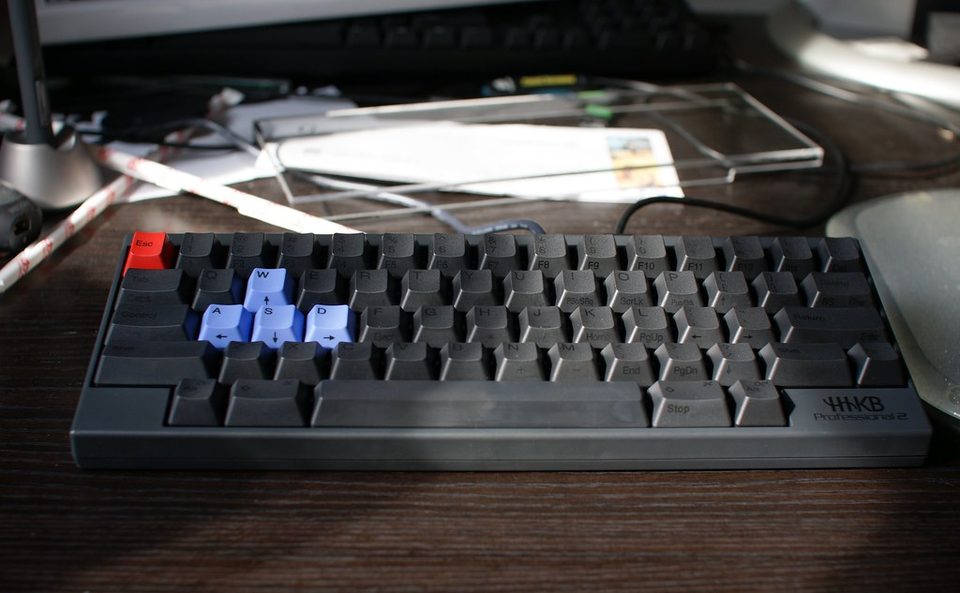
The best engineer I ever worked with, a man who could reconstruct a failing system in an afternoon, kept a keyboard at his desk that looked like a child's toy. Sixty keys, no number row, no function row, a Control key sitting where Caps Lock goes on every computer in the office. He'd been typing on one for a decade, carried it to every job, and when new hires mocked it, and they did, he had a single answer: I stopped relearning this in 1999. He meant the muscle memory, but he also meant something he never said out loud, that his hands had a contract with one object and the object had never broken it. Everyone else on that floor had been relearning something, a ribbon, a reorg, a new chair, roughly every two years, and he was typing on the same layout Professor Eiiti Wada had drawn in the nineties.
The keyboard was the Happy Hacking Keyboard Professional, made by PFU, a Fujitsu subsidiary, and the scene is the argument. The HHKB is not a mechanical keyboard with opinions. It is a keyboard that was finished in 1996 and has declined, with a consistency that borders on insolence, to be revised by every decade since.
The layout is the product
Start with the object, because it's genuinely strange. The Professional Hybrid is a 60 percent board: eleven and a half inches wide, 540 grams, no number row, no arrow keys as built. The layout is Wada's, from 1996, and its central move is swapping Caps Lock for Control and tucking Backspace and Delete into positions where a touch typist's strongest fingers live, because the layout was drawn by a computer scientist for programmers whose hands live on Control. The typing feel comes from Topre capacitive switches, a rubber dome over a spring registered electrostatically, a design that feels like nothing else and divides the keyboard world the way the Aeron's mesh seat divides the chair world. The Type-S variant adds silencing, and the 2026 hands-on review at Leaf&Core scored its sound nine out of ten, quiet enough for an office or a quiet train car, at a slight cost in tactility that the reviewer, a self-described tactility obsessive, put at seven out of ten (the review is here).
| Variant | Current street price | The difference |
|---|---|---|
| Professional Hybrid Type-S | $259 to $297 | Silenced Topre, Bluetooth |
| Professional Hybrid (standard) | about $275 | Unsilenced, more tactile |
| Professional Classic | about $285 | Wired only, unsilenced |
The Hybrid part is the wireless generation: Bluetooth to four devices plus USB-C, powered by two AA batteries that last about fifteen days. The batteries deserve more credit than the spec sheet gives them, and the reviewer ranked them ten out of ten: a device that takes AAs can be repaired by the entire world for the next fifty years, because the battery standard already exists everywhere, which is the opposite of every lithium pack sealed into a slab this decade. The price has crept over the years, $259 at Amazon and $297 at Newegg on the Tom's Hardware listings, and nobody in the category thinks it's cheap. The mechanisms are all in the service of a single design decision. Consider the incentive: PFU could add keys. It has chosen, for thirty years, to sell fewer keys at a higher price, which is either a scam or a philosophy, and the reviews keep landing on philosophy.
Thirty years without a revision nobody asked for
Now the deeper mechanism, and the reason this keyboard earns an essay in a series about tools that survive contact with reality. The HHKB has been in continuous production since 1996 with the same layout, and every technological excuse to change it has been absorbed rather than adopted: wireless arrived without changing the layout, silence arrived without changing the layout, USB arrived without changing the layout. The DIP switches under the keyboard carry the customization budget, and the software layer is modest by design, because the audience isn't people who want to redesign their keyboard monthly, it's people who want to stop thinking about their keyboard entirely. That's the exact inverse of the enthusiast market's direction, where boards ship with menus, screens, and swappable everything, and the comparison is clarifying. Customization is a subscription to decisions; the HHKB sells the end of them. The colleague in the opening scene wasn't eccentric. He'd bought an object whose vendor had committed to leaving it alone, and the muscle memory compounded at compound interest for twenty-five years.
The case against sixty keys, made honestly
The counterargument is serious and I want to state it properly. The HHKB is expensive and incomplete, and for most of the people who see it on a desk, the correct verdict is no. A writer who uses numbers daily will miss the number row; a spreadsheet person will miss the arrows so badly they'll buy aftermarket caps; the Topre feel is an acquired taste that costs $260 to acquire, against a $40 Logitech that does the job and a $150 enthusiast board that does more of it. The Type-S's silencing costs real tactility, as the Leaf&Core reviewer measured, and the enthusiast who wants quiet tactility can build something with Boba U4 switches that is both quieter and more tactile for similar money if they're willing to solder. The wireless implementation has real flaws: the reviewer's Bluetooth picked up interference and occasionally repeated characters, the battery-saver mode is annoying enough to leave off, and the keyboard cannot charge its batteries while wired, which is a deliberate choice that will infuriate anyone who wants one cable. And the niche argument cuts deeper than features. This is a keyboard for a workflow, Control-heavy Unix and Mac typing, that most working people don't have. It's expensive because it's narrow, not despite it, and narrowness priced at a premium is the definition of a luxury purchase. All of that is true. It doesn't change the verdict. It draws its border.
The variable is whether you finish
It depends, and the dependency is whether you type one way or many. Programmers, writers, and terminal people who've already noticed their hands living on Control: this is the last keyboard you'll buy until one breaks, and the muscle memory will pay the $260 back over a decade of not relearning. Everyone else: your hands haven't chosen a layout, and the price is paying for a philosophy you haven't bought into. Watch one variable over the next few years: the layout's immutability. PFU has held the line for thirty years while the enthusiast market around it turned keyboards into software, and the day the HHKB ships a "new layout" or a screen, the thesis is dead and the old boards will do what old Aerons do, hold their value in a market that understands what stopped being made. My colleague retired three years ago and they let him keep the keyboard, which tells you what the company thought it was worth. It's typing the same paragraph in a house he owns now. The contract has never broken.