Nicholas TongOdroid H4
41 / 46
the backup box that became the main box
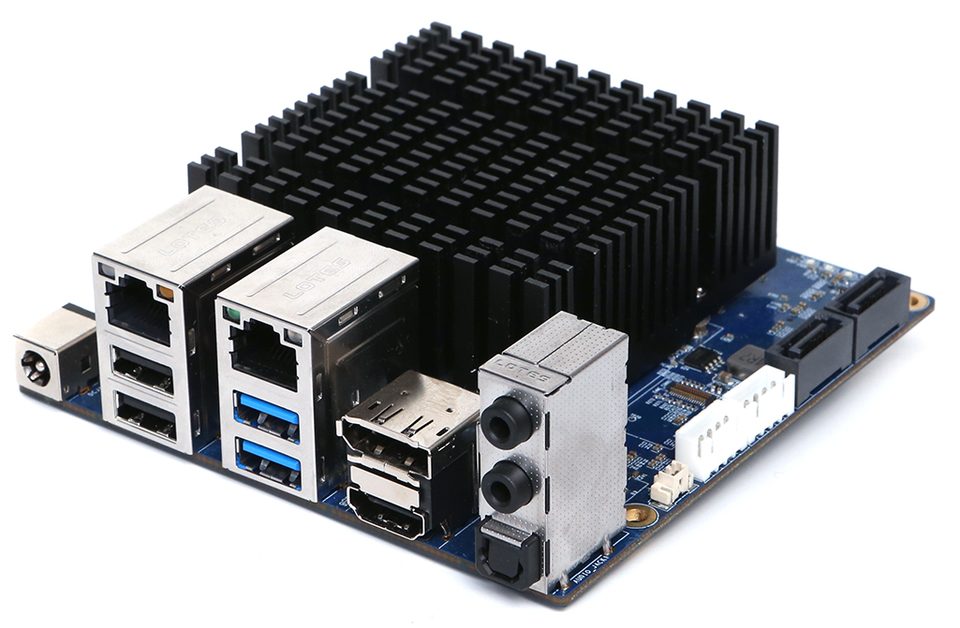
The swap happened at 2am on a Tuesday in March, which is when all of mine happen. The little Intel box that runs my VPN endpoint and my DNS had been sitting on a shelf as a cold spare for a year, powered off, because that is what spares are for. A transformer on my street let go during a thunderstorm and the spare became the primary in about six minutes. What I remember most is not the cutover. It is that I had to go find the barrel connector in a drawer, because the board does not ship with a power brick, and I own four different sizes of barrel connector and got it wrong twice.
Here's the thing. The Odroid H4 is a $99 bare board, or it was when Hardkernel could keep it in stock, and almost every review treats it like a tiny desktop. It is not a desktop. It is a security appliance that happens to be able to run a desktop, and the moment you think of it that way, every spec on the page starts making sense.
what it actually is
Intel N97, four Alder Lake-N cores, 12W on paper. One DDR5 SODIMM slot that tops out at 48GB. Two NVMe slots. Dual BIOS with a physical switch, which is the spec nobody circles and the one that matters most to me. Two HDMI ports, four USB, 2.5GbE on board. The H4 Plus and Ultra add a second 2.5GbE port, and that second port is the difference between a board and a firewall. Prices have climbed across the line in 2026, the Ultra is listing around $230 where it started much lower, and Hardkernel has suspended H4 production over Intel CPU supply, pointing people at the H5. None of that changes what it is for.
I want to be careful here, because I got this wrong for about two years. I used to buy ARM boards for this job. Cheap, silent, low power, great on paper. Then I would spend a weekend fighting a kernel that half the packages in the repo were not built for, and a Docker image that existed for amd64 only, and I would burn six hours on a Sunday doing archaeology in a Makefile. The H4 is x86. Everything that runs on a server runs on it, unmodified. That is the entire argument, and it is an argument about time, not performance.
the part everyone gets wrong
Everyone compares it to a Raspberry Pi 5. Wrong fight. A Pi is a teaching board with GPIO and a camera connector and a community that writes blog posts for you. The H4 has none of that romance and twice the boring reliability. The correct comparison is a used USFF office desktop, and against that the H4 wins on idle draw and loses on expandability, and you should price the whole kit before you decide it is cheap.
Because here is the number that decides everything: the $99 board is not the machine. RAM is extra. Storage is extra. The power brick is extra. By the time you have 16GB of DDR5, an NVMe drive, and the Type 3 case, you have spent north of $250 on paper and more than that in 2026, and you have spent an evening assembling it. I priced the identical build twice in 2025 and it moved by forty dollars between quotes, which is not a spec, it is a market.
the mechanics, in ops terms
The dual BIOS switch is the feature I did not know I needed. You keep the shipping firmware on one chip and a known-good image on the other, and when an update bricks the board at 1am, you flip a physical switch and you are back. I have done a BIOS update on a firewall box exactly once without a second chip, and I aged a year in eleven minutes. On a device that sits inline between my house and the internet, a rollback path that requires no extra hardware is not a nice to have. It is the purchase argument.
Beyond that it is a normal x86 box. Debian or Alpine, whatever you run anywhere else. Idles around 6W in my measurements, which matters on a box that never sleeps, because a security appliance that is off is not an appliance.
where it breaks
Memory ceiling, first. One SODIMM slot, 48GB on paper, and single-channel bandwidth. Fine for routing, VPN, DNS, a small service bucket. Not fine if the plan drifts toward ZFS with real datasets and dedup, because ZFS eats RAM the way Houston eats highway budget, and single channel is a tax you pay on every arc stat.
The N97 is a efficiency part. It will do AES-NI line rate on a WireGuard tunnel without breathing hard, and it will fall over the moment you point Suricata's full rule set at the same traffic with TLS inspection in front. The box I am describing is a router with opinions, not a network sensor. People buy it for the second job and then write angry forum posts about the first one.
Supply is the other break. Hardkernel has had the H4 listed as out of stock for stretches in 2026, and when a board with a dual-BIOS switch disappears, the practical answer is either the H5 or a used USFF desktop. Availability is a spec. Ask anyone who tried to buy one in August.
And the community is small. When the N97's undervolting options confuse you, you are reading a forum, not ten thousand Stack Overflow threads. I do not mind. I mind at 1am.
what to do
- Decide the job before the board. Router, VPN endpoint, DNS, small services: right tool. NAS with dedup or a real network sensor: wrong tool.
- Price the kit, not the board, and add 15% for the 2026 market before you compare it to anything.
- Put the second NVMe in from day one and image the first one monthly. Restoring from that image is the drill, and backups are not real until you have restored from them.
- Flip the BIOS switch once, on purpose, while nothing is on fire, so the rollback path is muscle memory instead of a wiki page.
- If you want two NICs, buy the Plus or Ultra, or budget a USB 2.5GbE adapter and accept that it hangs off the case.
One useless detail to close: the H4's stock heatsink has this pointed intake in the corner, and the case manual shows it sitting directly over the SSD thermal pad, so in my build the intake is aimed at a logo printed on a drive I will never see again. I left it. It bothers me every time I open the case, and I leave it every time.
I could be wrong about this, and if I am, someone will tell me. The honest framing is that the H4 is a really good board with a weird pricing shape, made by a company whose supply chain is at the mercy of Intel's leftovers, in a market where board prices moved faster than my ability to update this post. I paid for it myself, it sits in my closet running three services I would notice within an hour if it died, and it is not a purchase recommendation.
If you buy one, label the barrel connector before the drawer eats it.