Jason LeeMiro
Item 44 of 45
Miro rents the wall, and the wall remembers who stopped paying
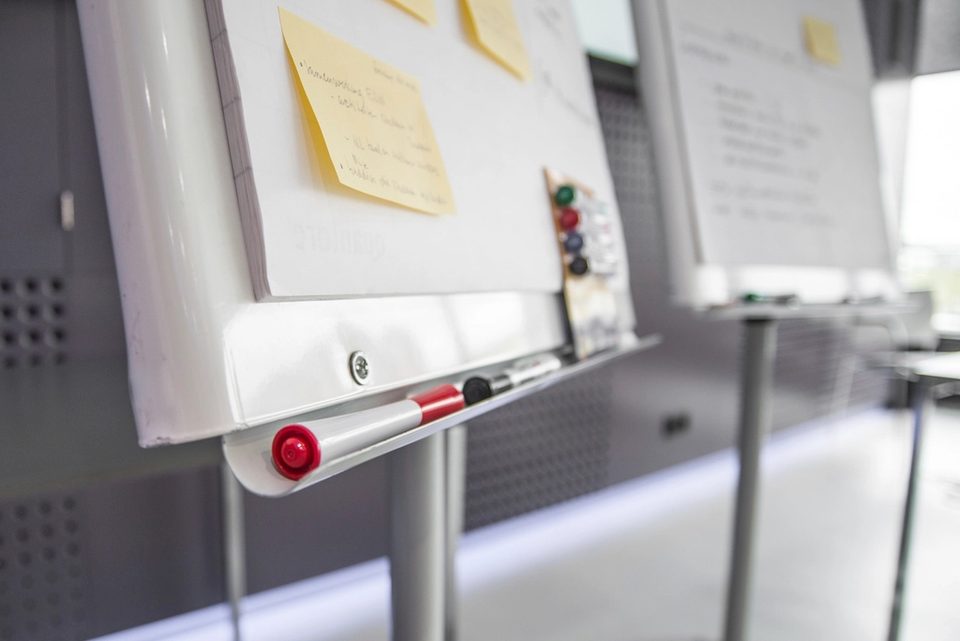
The most expensive-looking hour of my consulting career was a workshop in which nobody produced anything. Twelve senior people around a wall of glass, a facilitator with a stack of pink stickies and a marker, six hours of dot-voting and clustering and re-clustering, and the deliverable was a photograph of the wall taken on someone's phone, which circulated for a week and then did not. My contribution was two notes and one observation, made to my manager on the flight home, that the wall had voted down the only idea in the room with a number attached to it. He said the client had not paid for the number. He said it without irony, the way you would describe the weather, and I have thought about that sentence more often than any client work I did that year.
I open with the wall because Miro is that wall with a server behind it, and the server changed the stakes without changing the exercise. During the pandemic the company became the default version of it, riding to a $17.5 billion valuation in January 2022 on the premise that distributed teams still needed to cluster pink paper together, and the question in 2026 is whether the canvas survives its own success. The answer depends on a distinction the product has spent four years quietly erasing, between the wall you drew on and the wall you were billed for.
The board is the demo, and the demo is the funnel
Run the arithmetic of the free plan, because the arithmetic is the argument. Miro's free tier allows unlimited team members and unlimited board creation, with a catch that is doing all the work: only the three most recent boards remain editable, everything older freezes to view-only, and no board can ever be private. That last clause is the whole business model. Anything you put on the canvas is visible to every member of the workspace by default, which means the tool that sells collaboration as its soul cannot, on its free tier, let you keep a note to yourself. The paid ladder climbs from there: Starter at $8 per member monthly billed yearly, Business at $20 with the guest-editing rights and SSO, Enterprise as custom pricing with a thirty-seat floor. A pricing analysis checked against Miro's pages on August 28, 2026 adds the detail that matters: when you share a board for editing with someone outside the team, Miro tends to convert that person into a paid seat, and $20 a member against FigJam at $5 and Whimsical at $10 is steep once the bill passes ten editors. Consider the incentive, because it is unusually legible here. The workshop is the demo; the artifact is the lock-in. The more of your team's thinking accumulates on Miro's servers, the more expensive the exodus becomes, since frozen boards are readable but no longer workable, and exporting a workshop's worth of sticky clusters into a tool that speaks another shape is a project nobody budgets for. The whiteboard is free. The archive is the product.
The company billed like software and grew like a pandemic
Miro raised $400 million in January 2022 at that $17.5 billion valuation, which priced it at up to 58 times its 2021 revenue of roughly $300 million, per the Contrary Research breakdown. Then the conference rooms came back and the growth did not, and October 2024 brought an 18% layoff, about 275 of roughly 2,900 people, with reporting at the time putting annual recurring revenue above $500 million and trackers since estimating around $665 million. Both things are true. Miro is a real business with real revenue, and Miro is also the name for what happens when a tool whose value is measured in meetings gets a gift of universal meetings and then has the gift withdrawn. The industry understood that risk in 2021. Contrary's own thesis flagged that a valuation priced for pandemic growth would wobble if the growth slowed. It slowed. Consider the incentive from the buyer's side, too: facilities budgets bought whiteboards once, and collaboration budgets buy Miro monthly, per head, forever, which is why a canvas wants to be a platform, and why the 2026 roadmap leans into AI Workflows and "Canvas 26," an enterprise decision layer that Forrester's analysts describe as a bet the company can outgrow the wall it was named for. A whiteboard is a purchase. A platform is a rent. The distinction is the entire history of this company in one line, and the line runs through your renewal.
The artifacts are not the thinking
Here is the failure mode that no template gallery fixes, and I want to be fair to it. A wall of clustered notes feels like progress because it looks like the shape of thought, and it is not thought; it is the exhaust of thought. The workshop produces correlation-shaped clouds of adjectives that decay fast because nobody owns them, and the photograph of the wall was always the honest version: a record of a mood, filed accordingly. Miro does not create this problem. It inherits the workshop's economics and adds a subscription, and I will grant the strongest version of the counterargument before I land: distributed teams genuinely lost something when the physical wall went away, and Miro's canvas with voting and timers and Talktracks is the best reconstruction of it anyone has built. For a workshop-heavy organization, facilitation tooling at $8 a head is cheap against the cost of the meeting itself, and the counterargument is stronger than its own proponents usually make it, because the tool's peak use is genuinely good. But the peak use is the exception. The ordinary use is the frozen board from a workshop in March that nobody has opened since, and the ordinary use is what renews.
So the verdict, conditional and short. If you run facilitated workshops for a living or your team is distributed and meets in canvases weekly, Miro is the best version of the wall and the price is defensible against the meetings it replaces. If your organization's boards multiply and then go quiet, you are not buying a tool, you are buying an archive that bills per head, and you should price the export before the archive prices you. The variable worth watching is whether Canvas 26 turns the canvas into a decision system of record. If it does, leaving stops being a chore and becomes a negotiation. My manager was right about what the client paid for. He just never said what the wall cost, because on that wall, nobody had to pay yet.