Jason LeeKobo Libra Colour
Item 40 of 45
The reader that declines to own you
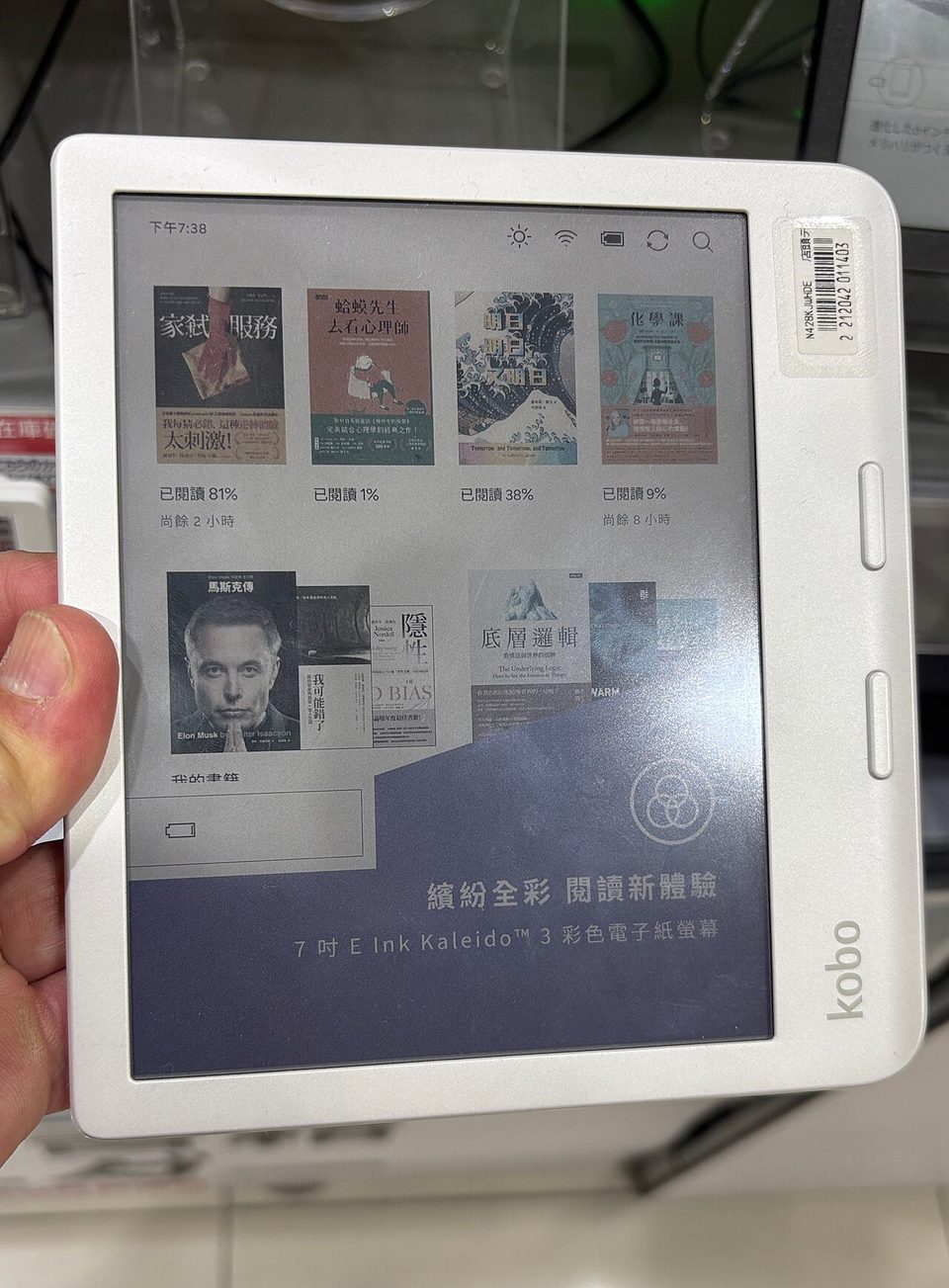
Seventy-one boxes when I last moved apartments, and eleven of them books, and the mover priced the eleven the way a surgeon prices a second organ he has unexpectedly found involved. A friend in the same building moved the same week with one box and a Kindle, and she watched my elevator load with something I took for pity at the time and have since re-catalogued as advertising, because the entire pitch of the e-reading industry is that the weight was never worth carrying. I kept the books and I have never regretted keeping them, and I have also never been able to lend her one, which is the part of owning a library that the quotations about libraries skip: a book on a shelf is an option you hold, and a book in an account is a license somebody else can edit. Eleven boxes is the price of the options. I have finally stopped pretending the price is invisible.
The turn is this: the Libra Colour, Kobo's $219.99 reader from April 2024, is a portrait of what a hardware company ships when it declines to build a moat. Kaleido 3 color E Ink, 300 pixels per inch for text and 150 for color, IPX8 waterproofing, 32GB, and two physical page-turn buttons on a bezel you can flip for either hand, the feature Amazon retired when it killed the Oasis line and left its readers entirely to glass (the state of the two platforms is well summarized here). Nothing in the specification is dramatic. The absence of a lock is the specification, and the absence is worth an essay.
What Rakuten sells by not building a moat
Walk through what the device permits, because the list reads like a jurisdiction with weak customs. It opens EPUB, EPUB3, PDF, MOBI, CBZ and CBR and a dozen formats Amazon stopped speaking. It loads books over a cable without a desktop app. It reaches your Google Drive and Dropbox. And it has OverDrive built in, which means your library card is a bookstore with a zero on every shelf, browsed and borrowed on the device itself. Consider the incentive, because this is the sharpest contrast in the category. Rakuten sells the reader at a premium and runs a store you are free to ignore, which means its profit is collected once, at the till, and the device's whole design logic follows from that fact: no lock screen ads, no store you cannot leave, no format you cannot smuggle in. Amazon prices its hardware near cost and collects rent on the library, the subscriptions, the audiobooks, the special offers, and the design logic follows that fact instead, which is why a Kindle shipped this decade can be a screen for advertising with a reading app on it. In August 2025 the company went further and stopped letting owners download their purchased books over USB at all. Nobody who bought those books was robbed, exactly. They were reminded, politely, of the terms of the shelf they thought they owned.
The color is a compromise you can watch
The honest part of the review is the screen, because color E Ink is a tradeoff you can see happening. The Kaleido 3 panel puts a color layer over the black and white one, so text stays at 300 PPI while anything in color drops to 150, and the palette arrives muted, pastel where the marketing says vivid, closer to printed paper than to a tablet, which the reviewers keep describing accurately and the store page keeps overselling. Dense PDFs and comic pages refresh with a visible shudder, and there's a flicker between pages that Android Authority flagged as a real question for anyone with visual sensitivity. And I want to defend the tradeoff rather than grade it, because what the color is actually for is narrower and better than the promise: covers on a grid, the difference between a comic and a fax of a comic, four shades of highlight when you mark up a chapter. The photo above is that pitch in miniature, a screen of covers in soft color, and what it does not show is that every book on that grid arrived from three different sources without anyone's permission. The color is a convenience. The door is the product.
The garden is genuinely nicer to live in
The case for Amazon is better than its lock-in deserves, and it starts with the store. Kindle's storefront, its recommendation engine, its Whispersync and its Audible plumbing are the best in the industry, and the Paperwhite costs a hundred and forty dollars less than the Libra while beating it on pure text contrast. For a reader whose books come from Amazon and who wants the cheapest sharp page in the house, the pragmatic choice is not a failure of character. The practical objections to Kobo are real too. Its own store is hard to browse, the OverDrive setup on my unit looped on login until a support rep prescribed a factory reset, and the optional $69.99 stylus lags enough that reviewers consistently call it a marginalia tool rather than a notebook. I bought the Libra the week the download change was announced, which makes part of this a disguised act of protest, and I have kept the Kindle anyway, because spite is a reason and not a plan. What the convenience case cannot purchase is the direction of travel. A walled garden is pleasant, and every year the walls are maintained, inspected, and raised, and the price of admission is already inside your account, collected in fractions, forever. The garden is nicer. It is nicer because you paid for it in a currency that does not stop.
So the verdict, shorter than the argument. If you read comics, cookbooks, children's books, or anything the library lends, and you'd rather own your shelf than rent it, the Libra Colour is the obvious machine, and the color is a bonus rather than the reason. If your books live in Amazon's store, moving them is a project, and color alone is not worth the project, and nobody honest will tell you it is. The thing to check in a year is whether Rakuten still ships hardware into a market this size, because a library you can carry out the door is worth exactly what the door staying open is worth. My mover still quotes in boxes. The eleventh is the only one I have never once considered leaving behind.