Jason LeeiA Writer
Item 19 of 45
The app that charges admission to the page you were avoiding
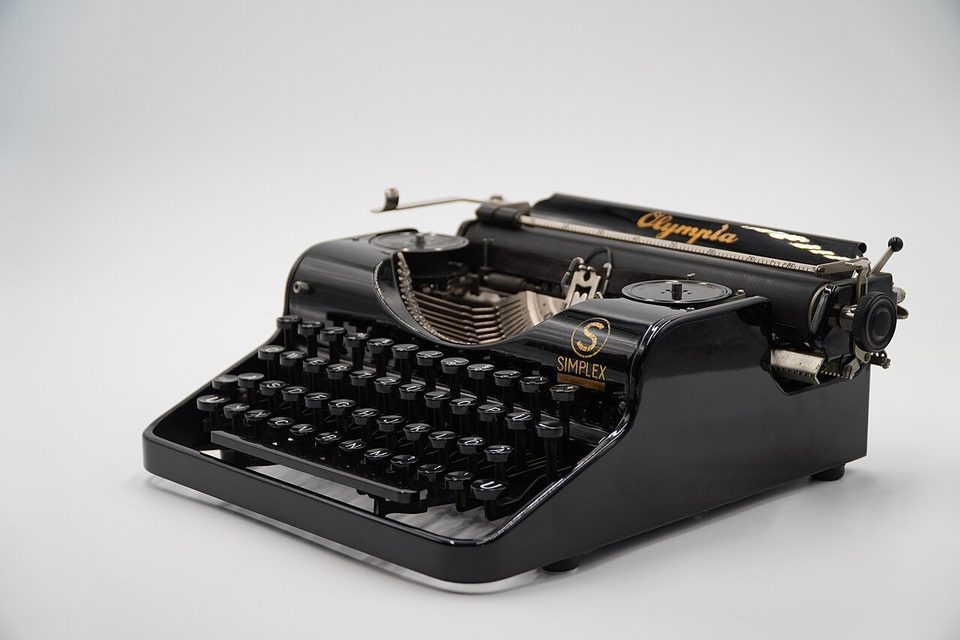
The typewriter above is not mine, but its arrangement is the one I grew up around. My father kept an actual typewriter on the desk in the room I was supposed to do homework in, a machine he had bought used in a decade I will not name, and the rule of the house was that you could write anything on it as long as you accepted two costs. Every mistake was paid for in paper, and every page was finished whether you liked it or not, because the thing in the platen had to come out before dinner or not at all. I hated both rules. I have spent most of my professional life noticing that every tool I respect is quietly re-imposing one of them, and every tool I have quit was promising relief from the other.
The turn is this: iA Writer is the second kind of tool, and it is honest about it, which is why it's worth an essay rather than a paragraph. The app costs twenty dollars on the iPhone, fifty on the Mac, once, and has held those prices for years, and in exchange it does nearly nothing. Plain text, Markdown, a font, and a focus mode that dims the sentence you are not writing. No plugins. No graph. No AI. In 2026 the no-AI is the loudest feature in the catalog, and the company's refusal is not a costume. Information Architects, the design firm behind it, has spent over a decade publishing essays about why they decline features, which is a business strategy, an aesthetic position, and, unusually, both at once.
Subtraction is a feature, and it is expensive to maintain
The mechanism is best understood as an economics problem, because deletion costs more than addition and always has. Any engineering team can add a graph view or an assistant; it takes one sprint and makes a demo sing. Holding a product at four features for fifteen years is the expensive discipline, the way a restaurant holding a seven-item menu is doing more work than the one with forty, and the App Store's four Editor's Choice awards alongside four times as App of the Year suggest the discipline pays in a currency Apple controls and users recognize. Reviewers in 2026 keep arriving at the same finding, which Bill Bennett's March review states as plainly as anyone's: it is the most productive writing tool he has used since he learned to type on a manual, which is a sentence about subtraction, not addition (the review is here). The user complaints, when you read them, cluster on the one axis the company refuses to move. Not enough fonts. Print templates too rigid. Windows version always last. These are the costs of the position, priced honestly at the moment of purchase, and I respect a product that makes you pay in the currency of its argument rather than hiding the bill in a settings panel. My own use is confession enough: this essay was drafted in it, over four evenings, and the thing I noticed across those evenings was how often my hand went looking for a button that was not there and how little I missed it once the sentence was finished.
The refusal is a product, and consider the incentive
The part most reviews skip is the incentive audit. A free writing tool with no AI is a novelty. A paid one with no AI is a bet, and the bet's shape tells you who the customer is: the person who pays fifty dollars once and is never billed again cannot be the product, because the revenue stops arriving the day they buy, and a company whose support forum answers with style documentation rather than upsells has organized itself around that fact. Contrast the arithmetic every other tool in this series runs. The subscription tools in my notes, the twenty-dollars-a-month tier I profiled two weeks ago, need your renewal, and their roadmaps are shaped by the renewal: more features, more surface, more reasons the invoice looks indispensable. iA's roadmap is shaped by the opposite pressure, the customer who got everything on day one and owes nothing, which means the only currency the company can spend is trust, and the only way to spend trust is to decline. Two things hold about this arrangement at once: it is commercially fragile, and it is the only structure I know that puts the developer's incentives on the writer's side of the desk.
The constraint reads as superstition, from the outside
The honest counterargument is that the constraint is mostly superstition, and I want to give it its full weight. The blank page did not need defending, it needed surviving, and the people who romanticize subtraction are usually people whose income no longer depends on volume. A content team producing forty pieces a month cannot pay a fifty-dollar one-time fee for focus mode, and if a drafting assistant moves their metric, the metric is the moral law of their workplace, not their weakness. There is also the sharp version, argued by every subscription developer in this series: features are not addiction, they are a market, and the market voted, and a small firm holding a purity position is not virtuous, it is simply small, with purity as the moat smallness affords. That argument has teeth. What it cannot explain is the date on the receipts. Fifteen years is not a moat built by smallness. Plenty of small companies add features frantically and die of it. The refusal has survived contact with a market that rewards its opposite, which is the only evidence in this business I trust.
So the verdict, conditional as always. If your problem is that the page stays blank, twenty dollars is the cheapest known intervention, and it works because it costs you something rather than despite it. If your problem is volume, the tool will not save you and was never trying to. What to watch is not the roadmap. It's whether the company can keep holding the price and the refusal in the same hand, because the day it ships an assistant, it becomes one more blank surface with a meter on it, and the machine my father kept by the window will be the only honest writing tool left in the house.