Jason LeeHerman Miller Aeron
Item 35 of 45
The chairs outlived the company
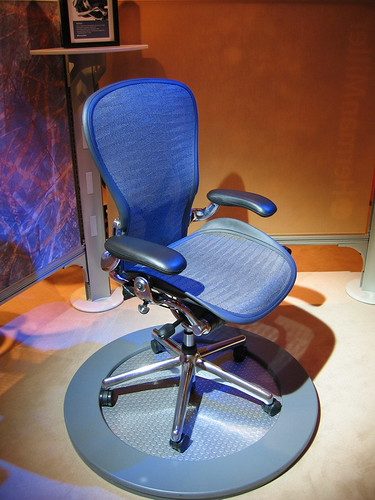
Eight years ago I spent two weeks on the wind-down of a client, a consumer app company that had run out of runway in the usual order: employees, then morale, then the lease. The liquidator walked the empty floor with us, pricing everything at cents on the dollar. Desks went for almost nothing, the monitors went for less, the espresso machine went to somebody's basement. Then he got to the chairs, eighty or so Aerons in a size that suggested the recruiting had been narrow, and his whole manner changed. The chairs, he said, would move at five hundred each within the week, cash, no negotiation. He'd been liquidating startup offices for fifteen years and had stopped being surprised by it. Laptops were scrap by the time a company died; the chairs came back like furniture. The chairs held their value better than the company had, and he said this without any judgment at all, which is why I've kept the sentence.
I think about that liquidation whenever the Aeron's price comes up, because it's the most honest price signal in the category. Most tools in this series are priced by their makers and re-priced by their owners' regret. The Aeron is priced partly by a resale market three decades deep, and the market has been telling the same story since the first dot-com died: this object survives its buyer.
The warranty is the product
Start with the object, because the reputation is load-bearing and mostly accurate. The Aeron launched in 1994, sits in MoMA's permanent collection, and was remastered in October 2016 with the 8Z Pellicle, an elastomer mesh across seat and back in eight tension zones, with no foam anywhere, which means nothing to flatten, compress, or trap heat. The 2026 revision made it lighter and stronger and added colors, and reviewers who have tested dozens of chairs keep scoring its build quality at the top of everything they've seen, 95 out of 100 in BTOD's 2026 teardown against a seat-comfort score of 66, which is the honest tension in one pair of numbers. The seat is firm and bolstered, the fit comes from three shell sizes rather than levers, and a wrong guess presses the mesh edge into your knees, because there's no seat-depth adjustment to rescue you. The warranty is where the price stops looking like fashion: twelve years, valid for three-shift around-the-clock use, parts and labor included, with no excluded components, cylinder, casters, and mechanisms all covered (the full market breakdown is here). A standard configuration lists at $2,150, base versions start around $1,520, and the fully loaded chair reaches $2,685. Amortized across twelve years of working days, that's roughly seventy cents a day for the surface your body actually touches.
The secondary market does the price discovery
Now the part no other chair in this series has, and the reason the liquidator's sentence was data. The Aeron is sold through four channels at once, and they're priced against each other:
| Channel | Price | What you get |
|---|---|---|
| New, Herman Miller | $1,620 to $2,685 list | Current design, 12-year warranty |
| Factory refurbished | $945 to $975 | Current design, 5-year warranty |
| Remanufactured Classic (Crandall) | $799 | 2016 design, rebuilt, 12-year warranty |
| Used, as-is | $400 to $1,000 | Whatever the cylinder has left, no warranty |
Most chairs have a discount rack. The Aeron has a market, and the depth of it comes from the corporate overbuying of the nineties and two-thousands, thousands of chairs bought for companies that no longer exist, professionalized into a refurb trade. Consider the incentive on each side. Herman Miller runs its own refurb program and calls it the only authorized one, which lets it price the current-design chair with a shortened warranty just under four figures. Crandall competes by rebuilding the older Classic and matching the twelve-year coverage at $799, and the as-is market is a gamble on a gas cylinder you can't inspect. And one caution about every number above: each source here sells chairs, directly or by commission, and the reviews are useful precisely because the chair is real, but the showroom demo is always a size B adjusted by a professional, and yours will be whatever the shipping container brings. The market is honest. The point of purchase is not.
The case for the cheap chair, made honestly
The counterargument is that the amortization argument is a wager on your own continuity, and most people lose it. Tom's Guide's favorite office chair overall costs a quarter of the Aeron's price with a seven-year warranty, and for a body that wants a soft seat, the Aeron's firm mesh is a dealbreaker rather than a trade-off, which the 66 out of 100 comfort score records without embarrassment. There's no headrest and never has been from the factory, so the tall sitter adds an aftermarket part at about $190 and voids nothing but the design's purity. The Steelcase Leap's remanufactured market offers the deal the Aeron structurally refuses: the same chair, rebuilt, at roughly half price with the full factory-length warranty. And the deepest cut comes from the reviewers themselves: a wrong-size or worn-out Aeron is a worse chair than a right-size one for two hundred dollars, which means the premium buys nothing unless the fit is certain, and fit certainty is exactly what a person buying blind online does not have. All of that is true, and the strongest version of it is this: the Aeron's price is an argument about time preference, and the people it persuades are the people who already know they'll be at the same desk in 2038.
The variable is the refurb gap
It depends, and the dependency is your decade. If you sit eight hours a day at one desk, run warm, fit clearly inside one shell size, and mean to keep the chair past the warranty, buy it new with the PostureFit SL back, or take the $945 factory refurb and pocket the six hundred. If you move offices the way I moved out of consulting, buy the $799 Classic reman or the five-hundred-dollar liquidated one and let the market do its work. Watch one variable: the gap between the official refurb program and the independent remanufacturers, because that spread is the company's honesty dividend. If Herman Miller ever narrows the warranty gap on its own refurbs, the case for paying full price weakens by exactly that much. The liquidator was right about the chairs, and he was telling me something larger without knowing it. The object outlasted the organization, the financing, and the app, and I've never decided whether that's a compliment to the chair or a diagnosis of everything else we bought.