Nicholas TongMidland WR120 NOAA Weather Radio
48 / 56
the most reliable alert in my house has no IP address
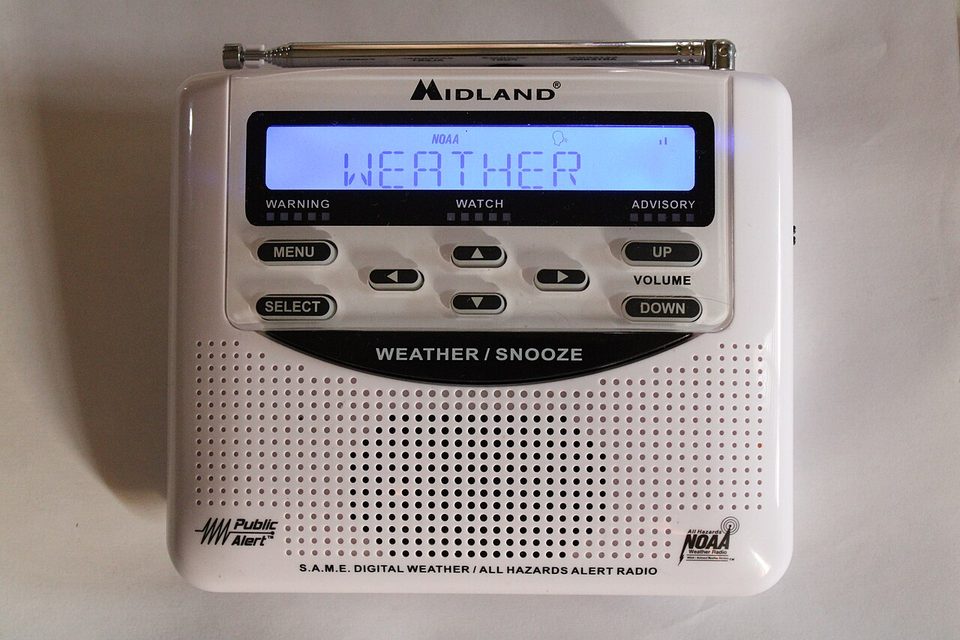
The siren went off a few minutes before eight on May 16, 2024, while the derecho was still chewing the west side. Ninety decibels out of a $55 plastic box on the bookshelf, right next to the pothos I've kept alive for two years out of spite. My phone was face-down on Do Not Disturb and stayed there the whole storm. The box doesn't have a Do Not Disturb mode. That's most of the review, but I'll type the rest anyway.
The wind that hit downtown that evening was measured around 100 mph, which is hurricane arithmetic in a spring storm. While it went through the grid, I stood in the hallway holding the radio, and I kept thinking about what it needed to keep working: one VHF transmitter in Tomball, thirty-some miles north, and three AA batteries. No cell tower. No carrier, no app, no account, no update schedule. No IP address.
the part everyone gets wrong
Setup. People put the box on the shelf, plug it in, and call the job done. The WR120 ships unconfigured, and if you never program the SAME county code, the radio either stays silent or screams for every county it can hear, and from Houston it can hear a lot of counties. SAME, Specific Area Message Encoding, is the little packet inside every NOAA broadcast that names the counties the alert applies to. Harris County's code is 048201. Enter it, and the radio stops crying wolf about tornado warnings three hundred miles away.
For the first eight months I owned mine, I never did. Then a 3am tornado warning two counties east taught me the drawer test, which is the test where you throw the thing in a drawer. I did all the correct-sounding things. I owned a weather radio. I had never configured it. An unconfigured detector is furniture, and I had eight months of furniture.
the alert pipeline, end to end
A detection engineer's read of this thing is short: it's an alert pipeline, and the interesting part is how few hops it has. Somewhere a forecaster at the National Weather Service writes the warning. A system encodes it with SAME. A transmitter pushes it out on one of seven VHF channels between 162.400 and 162.550 MHz. Harris County's main one is KGG68, 162.400 MHz out of Tomball, running 1,000 watts. Then a $55 receiver, tuned to that channel, decodes the county code and fires a siren and a text readout. Source, encoder, transmitter, receiver, display. Five hops, and two of them are the same box on my shelf.
Compare that with the pipeline on the phone that was face-down on DND that night. Alert originator, app, push service, carrier, tower, handset, notification settings, battery state. Every hop is a company or a config screen, and every one of them was between me and the warning while the wind took out feeders. The radio's path has fewer parties to bribe, outages, or misconfigure. On the night the grid got slapped, it was the only thing in the house with a working alert source, and it worked off wall power like nothing was happening.
That's the framing I'd hand to anyone who thinks a weather radio is a gadget for people who camp. It's not a gadget. It's a broadcast-grade alert feed with a siren on it, and it costs about as much as two months of a streaming subscription.
where it breaks
Upstream. The single point of failure isn't in the radio, it's in the transmitter, and mine proved it: KHB40, the station for the Galveston side of the bay at 162.550 MHz in Hitchcock, burned on March 25, 2025 and stayed dark for months. A temporary transmitter came back around August 15. If you lived on that side of the bay and your receiver was parked on KHB40, your "most reliable alert" was reliably nothing for almost five months.
Here's the part that matters: the radio never told anyone. There is no health check on a broadcast. The receiver can't know the feed went silent, because silence looks like a slow Tuesday, the same as a day with no weather. Any detection engineer will say the same sentence about any alert source: one with no heartbeat test is a hope, not a pipeline. I've tuned out of existence more SIEM rules than I can count, and a dead rule and a quiet day are indistinguishable until you look. The radio has the same failure mode with 1970s technology and no dashboard at all.
The second break is upstream too: the people. NWS lost roughly 600 of its 4,200 positions by spring 2025, then was authorized to rehire 450. I want to be careful here, because this isn't a partisan point, it's a headcount point. Every alert my radio repeats is written by a person on shift, and the staffing of those shifts is an operational number, the way headcount at a NOC is an operational number. There's a bill for the network itself, the NOAA Weather Radio Modernization Act, which passed the House Science Committee in March 2026. Its floor status is, as of this week, unknown. The Commerce OIG's report on the July 2025 Hill Country flooding, OIG-26-017-I from this past April, is worth reading as an operations document. It's an account of what an alert chain looks like when pieces of it are missing, and it's not framed as fear. It's framed as findings.
what I'd actually do
- Buy the WR120. It lists at $54.99 direct from Midland, street prices run well under that, and there's no subscription and no account. The Bob Vila roundup that last updated in January 2025 ranked it best overall, and their testers got a real small-craft alert fire during testing, which is a better demo than anything in the marketing copy. The WR400 at $109.99 is the same idea with a bigger display. You don't need it.
- Program the SAME code the night you buy it. Harris is 048201. It's a menu tree and ten minutes, and it's the difference between a detector and furniture.
- Put lithium AAs in it. Mine are the same ones I buy for the door locks, which is either planning or a coincidence, I haven't decided.
- Listen for the weekly test. NOAA runs scheduled test broadcasts. If your radio doesn't chirp on test day, you have a finding, not a radio.
- Know your transmitter's name and frequency. When a fire story mentions a station going dark, you need to already know whether that one is yours.
My dad spent thirty years as a machinist by the ship channel, and his test for any safety equipment has been the same since I was a kid: does it still work when the power's out. In this house exactly one alerting device passes that with three batteries and no other help, and it's the one with no firmware.
Do Not Disturb is a config file too.