Jason LeeObsidian
Item 02 of 45
The graph view is wallpaper
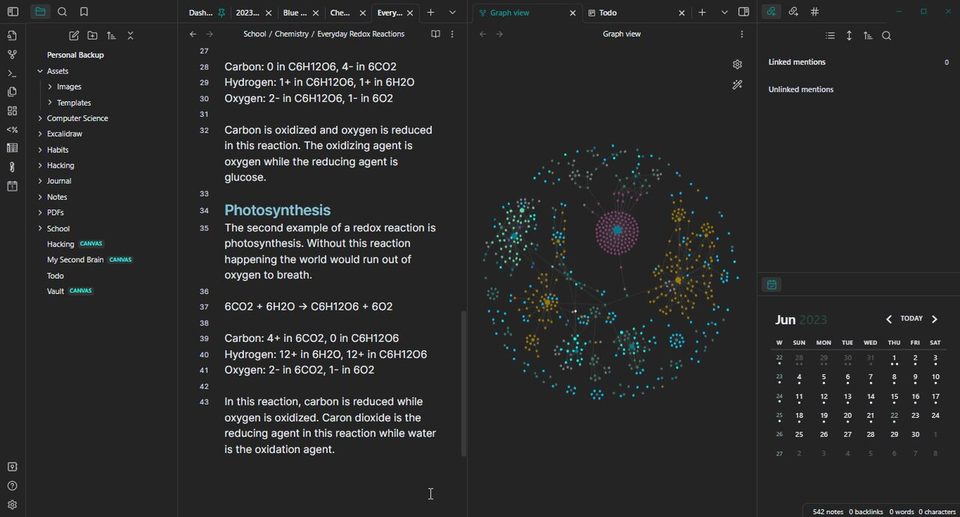
A friend opened his laptop at my kitchen table last spring to show me the thing he had been building for two years. It was his Obsidian vault: fourteen thousand notes, forty-one plugins, a graph view with clusters of colored nodes that looked, honestly, like a nebula. He rotated it. He zoomed into a cluster about a novelist we both admire, then another about cognitive load. I asked him what he had written with it. He looked genuinely startled, and then he said something I have thought about more than the vault itself: that was the wrong question. The vault was not for making anything. It was for holding. He published two essays in the time he has owned the tool.
That answer is the argument. Obsidian's pitch is that structure should emerge from writing rather than precede it, and for most of the people building vaults, the structure arrives and the writing never does. The tool is not broken. The promise is just easier to consume than the practice.
Ownership is real, and it is the wrong thing to be impressed by
Start with what Obsidian gets genuinely right, because the credit is deserved and I want it on the record before I take anything away. Your notes are Markdown files in a folder on your disk, inside what the app calls a vault. There is no telemetry and there is no web app; the company, Dynalist Inc., was founded by Shida Li and Erica Xu, who built it during the first pandemic year and ran it as something Fast Company later called the cult of Obsidian, a community of maybe a million people by its own download-count estimate. Steph Ango joined as chief executive in 2023 and the pitch since has been blunt: one hundred percent user-supported, free from investor influence, which is a marketing line that happens to also be an accounting statement. Sync costs four dollars a month and Publish costs eight; the commercial license is fifty dollars a user per year and is, by their own FAQ, encouraged rather than required, an honor-system tax on companies who like the idea of the thing surviving. The core app is free for personal and commercial use. Compare that to the workspace where I lost a metric definition last year, where the exit plan is a fire drill. Here the exit plan is cp.
So the incentive audit comes out almost embarrassingly clean. The company is paid by a few dollars a month from people who could sync with a folder of text files and a shell script instead, which means its only durable business is being worth paying voluntarily. Nobody in this transaction is buying reach or ad inventory or an enterprise contract. And yet. Ownership of the files is not ownership of the thing the files were supposed to become. This is the part the cult papers over: a vault you own completely, of which you have written nothing, is a hard drive with extra steps.
The meta-work is the product
The interesting mechanism is that Obsidian does not sell note-taking. It sells system-building, and system-building is a hobby with the grammar of productivity. The plugin directory extends the app with thousands of community add-ons, and the reviews, the friendly ones anyway, will tell you the same thing PCMag's eventually did: the learning curve is real, the useful features often live in third-party plugins rather than the core, and tailoring the thing to your liking takes significant time. Time is the operative word. The tool rewards tinkering immediately and rewards writing in months, and human beings are well documented to prefer the reward on the shorter time horizon, particularly when the short-term reward involves config files. The Zettelkasten comparison does the rest: the method's famous proponent, Niklas Luhmann, produced roughly seventy books from a card index, which gets cited as proof the system works, though it rather obviously proves Luhmann worked. The cards did not want to write a book.
I am not above this. I have a vault. It has a MOC, a map of content, for a book I have not started, and I spent a Saturday once building a dataview that would surface orphan notes, and the orphans are still orphans. The graph view is the most honest tell in the entire category. It is beautiful, it is interactive, and it conveys a sensation of connectedness that no reader will ever experience, because there is no reader.
The system builders are not wrong
The counterargument deserves better than a shrug, so here it is argued properly. For a specific kind of person, the analyst with a twenty-year question, the lawyer with a body of precedent, the researcher whose raw material is genuinely cross-referenced, the compounding is real and the ownership is load-bearing. They will read these notes in 2036 and the files will still open, which no subscription product can promise them. There is also the strategic argument, which Ango made plainly in a 2025 interview: productivity tools need community more than they need AI. In a market full of demo-driven vendors whose products get acquired, gutted, or pivoted out from under their users, the anti-demo tool is itself a kind of demo. Obsidian cannot rug you. That is worth something, and it is worth more every year, and the people who feel that are not being irrational. They are being patient.
Both things are true. The tool is the cleanest in its category, and the category's central activity is cleaning.
It depends, then, on what you are actually buying: a place to think, or a place to postpone thinking, and the honest diagnostic is embarrassingly simple. Look at your graph, then look at your published work, and if the first one has grown and the second has not, you did not buy a tool. You bought a room.
The variable worth watching is the vault's new landlords: the AI agents that will soon be invited to read it. Ango has resisted so far, and the plugin layer has not. My friend is still deciding which agent to let in. The nebula looked better before it had a tenant.