Jason LeeJira
Item 04 of 45
The ticket system is the org chart, printed on purpose
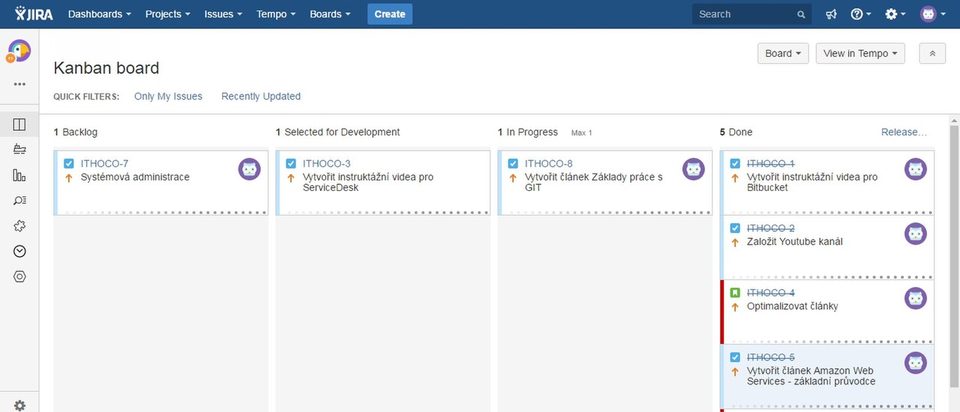
Some years back, at a payments company I was doing a six-week diagnostic for, a product manager wanted to rename a field. Not a workflow. Not a permission. A text label, from "Story Points" to "Effort," because the number was not points and never had been and the argument about it was consuming a meeting every other week. She filed the request the way the instance required, which meant a change ticket, which meant her manager's approval, which meant the Jira administrator, who was one person with a queue, and the queue for configuration changes was four days longer than the queue for production bug fixes. Eleven days after she first asked, the label changed. I remember the change ticket number, roughly, because there was a joke going around the team that the label had earned its own ticket history, its own comments, its own subtasks. The bureaucracy to change the bureaucracy had produced an artifact with a birthday.
I have thought about that ticket number for a decade, because it is the cleanest proof I have of what Jira actually is. It is not a tool that failed to stay simple. It is a system that does exactly what it was purchased to do, and what it was purchased to do is not tracking work.
A thousand dials, and one person holding them
Jira has been selling configurability since 2002, when Atlassian, founded that year in Sydney by Scott Farquhar and Mike Cannon-Brookes, shipped it as a bug tracker named after a nickname for Bugzilla, itself riffing on the Japanese title of Godzilla. The Wikipedia history treats it as software, which is technically true, the way a blueprint is technically paper. What the two decades of dials have produced is a category where every organization rebuilds its own government: workflows, schemes, custom fields, permission schemes, issue types, boards configured per team and reconciled per department and fought over per quarter. The configuration has a maintainer, and the maintainer has a queue, and the queue has a politics. I have met the maintainers. They are serious people, and they are the only ones who know why the deployment workflow has four approval gates, and they will tell you it is because of the audit in 2019, and they are the institutional memory now. The tool is load-bearing because it holds the thing nobody wrote down.
This is why Jira demos badly and governs well. There is no demo of a configured Jira, because there is no such thing as a Jira that is not someone's specific bureaucracy. The product page shows a board. The product is the form.
Follow the meter, then read the shape
Consider the incentive, because it explains the shape. Atlassian trades on the NASDAQ and reports revenue in the billions, and the money arrives per seat: the published cloud pricing for Jira Software runs $7.91 per user monthly on Standard and $14.54 on Premium, tiered upward as headcount grows, with Enterprise at negotiation. The buyer is not the engineer who files tickets. The buyer is an organization, usually procured by someone who will never log a ticket, and when the customer is an org rather than a person, the product is shaped to expand orgs: more seat types, more products bolted on, a Marketplace of third-party apps launched in 2012 that became a toll road with its own economy of resource planners and roadmapping add-ons and ScriptRunner scripts, several of which are now load-bearing at companies that could not tell you who wrote them. Then there was the migration. Atlassian ended support for self-hosted Server licenses in February 2024, pushing every remaining installation into its cloud or its Data Center tier, which was announced as a platform strategy and priced like a revenue event, because it was one. Each of these moves is rational. Together they describe a company whose income grows when the bureaucracy grows, and Jira is the bureaucracy's landlord.
The complaints you hear from engineers are accurate and slightly beside the point. Slow, cluttered, opinionated in the wrong places, a thousand clicks where Linear needs one. All true. Also true: the people paying do not experience those clicks. They experience legibility.
The bureaucracy is load-bearing
Now the counterargument, argued properly, because it deserves it. At enterprise scale, the thousand dials are not decoration; they are how a regulated organization remembers what happened and who approved it. A bank that cannot reconstruct why a change reached production is a bank that fails an audit, and an audit trail with four approval gates is exactly what its general counsel ordered. The field rename that took eleven days took eleven days because somewhere underneath was a control the regulators could read. Jira Service Management carries ITIL-flavored change management for this reason, and the flexibility everyone mocks is the flexibility to encode obligations that genuinely exist. There is also depth that the young trackers do not have: integrations with every source control system on earth, a release machinery, twenty years of third-party tooling for problems that only appear at five hundred engineers. An org can outgrow Linear. Nobody outgrows Jira; they just leave it configured worse than they found it.
Both things are true. Jira is the only product in its category built for institutions, and the institution it builds is yours, whether you meant to found one or not.
It depends, then, on whether the bureaucracy is intentional. If your organization genuinely needs an auditable process, Jira is not the cost of the process; it is the process, written down where an auditor can read it. If your organization does not need that, adopting Jira is how you get one anyway, with a queue and a maintainer and a committee, delivered as a subscription.
The variable worth watching is what happens when agents start filing the tickets. The governance in these systems was designed for human caution, humans who hesitate, escalate, and get tired of their own forms. Software that files change requests at machine speed inside a machine built to slow change requests down is a collision the industry has priced in and nobody has tested. The label did get renamed, in the end. Eleven days, four approvals, one field. The meeting it was meant to kill still happens.