Jason LeeFocusmate
Item 48 of 55
Focusmate sells the colleague you quit to get away from
At ten on a Tuesday night, in the lobby of a hotel whose name I have forgotten, four laptops were open at four adjacent tables and the only sound was typing. The typists had never met. We worked for three rival firms and were all chasing the same client, and every one of us had arrived at the same trick without ever discussing it: do the work where other people can see you doing the work. Nobody reviewed anybody's output. Nobody knew what anyone else was drafting. The accountability was entirely optical, and those were the most productive and least defensible hours of my week, least defensible because the mechanism had nothing to do with merit. A stranger's glance was doing what six years of training was supposed to do, and leaving the lobby would have required announcing, to witnesses, that I was done pretending for the night.
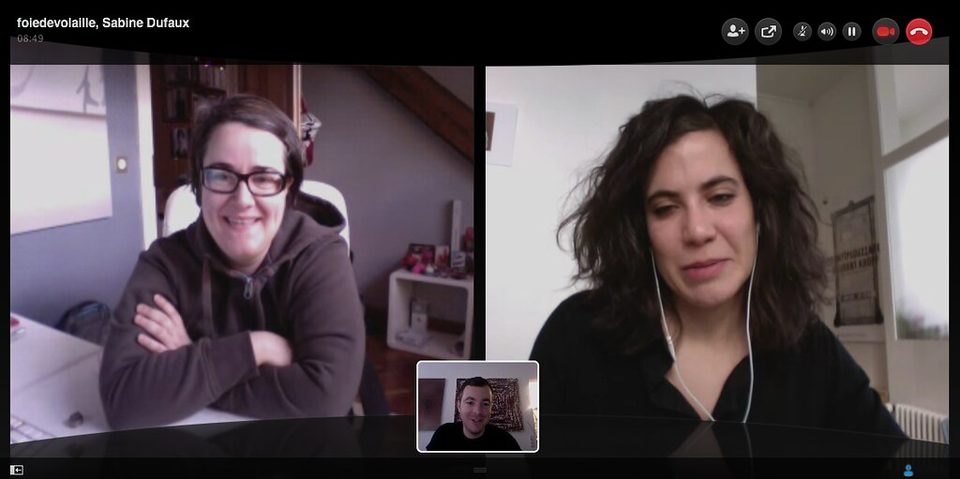
Eighteen months ago I quit with a modest runway and no plan, and my days lost the lobby along with the job. Nobody saw me at all, which had been the entire point of quitting and turned out to be a price I had not negotiated. I tried the usual repairs. Then, on the recommendation of a stranger online, I booked a fifty-minute session on a service I had assumed was a parody: a website that pairs you with another human being, on camera, in silence, to work. We said hello, we worked, we said what we'd done, we hung up. It worked. I resented how well it worked, and I'm writing this to find out why.
Two strangers and the cheapest commitment device in software
The mechanics are almost insultingly simple. You book a session like a dentist's appointment, the service matches you with someone in another time zone for whom your ten a.m. is their evening, the camera stays on, and the fifty minutes belong to the two of you and to whatever you each claimed you would do. There is no task management, no tracking software, no analytics dashboard. The product is a witness with a schedule, sold as three sessions a week free or unlimited for $8 a month billed annually, which rose to that price on January 1, 2026 from $6.99, with monthly billing at $12 up from $9.99, per a notice archived in late December before the change took effect.
Note who that pricing is aimed at. Three sessions a week is enough to build the habit and not enough to run a workday on, so the free tier is a staircase, and the person who climbs it has already conceded something the job never asked him to concede: that he cannot govern his own afternoons. The paid tier earns from people who have lost an argument with themselves, which is a customer with an unusually clear incentive to keep paying, and an unusually painful one to be. I've been on both sides of that sentence this year.
The vendor surveyed its own members and announced a triumph
Now the incentive audit, because the company's headline number is doing a lot of work in its marketing. In February 2024 Focusmate surveyed 834 of its own members and reported that members had achieved a 143 percent productivity gain. Read that sentence slowly for its construction: the seller ran the survey, the sample is people who stayed subscribed, and the metric is self-reported, meaning it measures how members feel about a service they chose to keep paying for. A survey is not a trial, and a cohort of the retained is not a population. The 143 percent tells you the marketing department needed a number; it does not tell you what happened to the people who signed up and quietly stopped booking, which is the population any honest evaluation would care about.
My incentives here are also visible from space. I write essays for a living on a schedule with no external structure, so a tool that manufactures structure is a tool that flatters my current life, and I have an interest in believing it works. Consider the incentive from the other chair, too. The stranger on camera has no stake in my work at all, and that is precisely why the arrangement functions: a colleague would ask questions, a manager would judge, and the witness only needs to exist. The whole design spends its effort on making sure nobody does anything, which is the most counterintuitive product decision I've reviewed this year.
Body doubling was real before the app, and the willpower framing was the mistake
The strongest argument for Focusmate does not come from its own survey, and it ought to embarrass the productivity industry that produced this product category. Tessa Eagle, Leya Breanna Baltaxe-Admony and Kathryn E. Ringland studied body doubling with 220 neurodivergent participants for ASSETS 2023, the ACM conference on accessible computing, published in October 2023, and their account treats the practice as a continuum of shared space, time and mutuality rather than a hack. People with ADHD have used body doubling for years, long before software existed to schedule it, because the difficulty was never a shortage of willpower. Treating focus as a character test is the actual mistake, and an entire genre of software has been selling cartoon versions of that test back to the people who failed it.
This is where I have to argue against something I wrote myself. In my essay on Slack I claimed presence is not the same as progress, and about chat that remains true. It was never true of the lobby, and the difference is mutuality. Slack tells you that others are there, which is ambient and ignorable. A body-doubling session shows you to someone, which is specific and not ignorable, and the research suggests that mutuality is the load-bearing part. A stranger's structured attention for $8 a month is also, not incidentally, cheaper than any coworking lease I have ever held, and I have held several, mostly to sit in rooms like that lobby.
It depends, in the end, on whether you treat the session as an appointment or a mood. Booked the night before, it functions; left to be booked when you feel like working, it inherits the exact failure it exists to fix. The variable worth watching is whether the free tier survives its own funnel economics, because the lobby only worked as a public place, and the price is where the public part gets decided. I left the office to stop being watched, and now I pay eight dollars a month to be seen.