Jason LeeElgato Prompter
Item 55 of 55
The Elgato Prompter makes a script look like conviction
The town hall rehearsal ran in a booked conference room the night before a client announcement, and the partner was doing what he called getting the rhythm of it. He had slides, and he wasn't using them. What he was using was an analyst, me, holding a laptop at knee height beneath the mounted camera with the remarks on the screen in 24-point type, scrolling with the trackpad at whatever speed his eyes demanded. Somebody had taped the laptop to a music stand borrowed from an office that ran an open-mic night. He read the whole thing straight down the lens, twice, and nobody in the room thought anything of it. This was how it was done, everywhere, and everyone knew that everyone knew. The next morning the client's communications lead pulled me aside and said, without a hint of anything in her voice, how natural the partner had sounded, that you could tell the remarks came from the heart, that some people just have it. I said nothing. The remarks had been drafted at one in the morning by a committee of four, and the partner had read every word of them, once off my knee and once off glass.
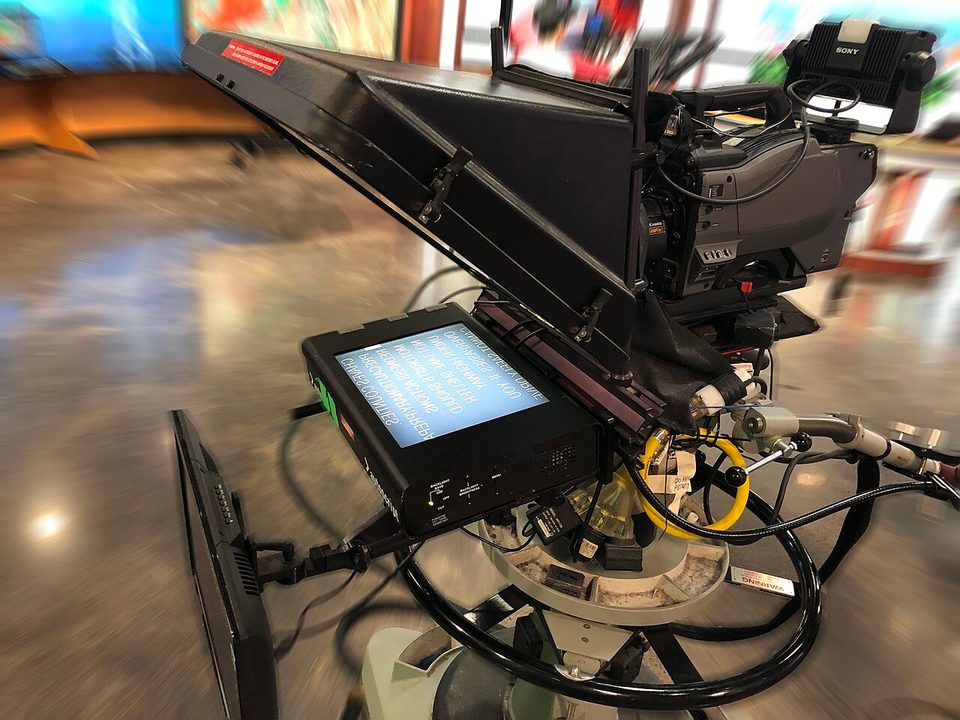
Eye contact is one of the oldest signals people use to judge confidence and candour, and it is cheap to fake because the checking machinery is old too. The Elgato Prompter, launched in October 2023 by Elgato, the peripherals brand owned by Corsair, is a nine-inch display in a hood that mounts in front of any camera, with beam-splitter glass between the lens and the reader: the camera sees straight through the glass, the text on the display reflects up into your eyes at the exact point the lens occupies, and you read while holding the gaze. The price is $299.99 direct from Elgato as of this month, up from the $279.99 it launched at in a rise nobody has properly explained, and under $220 at some retailers. What the device does is hold the signal while quietly dropping the behaviour behind it. The prompter doesn't make you fluent. It makes fluency unnecessary, which is a different and considerably larger product.
The glass is the honest part
Mechanically, the Prompter is broadcast's oldest trick miniaturised and priced for a desk. Beam-splitter glass, a 70/30 split, sits at 45 degrees; the camera hides behind it and shoots through, while a display beneath reflects the script into the reader's eyes. Anchors have read from this arrangement for decades, and heads of state have read from much larger ones, beginning with a soap opera stagehand's invention in the 1950s that reached a presidential campaign before it reached anything else. What Elgato changed is who gets the arrangement. The device works with any camera, phone or tablet, runs from its own built-in screen so no second monitor is required, doubles as a normal display when nobody is performing, and scrolls whatever window you drag onto it. Jan Ozer reviewed it for Streaming Media in August 2024 (the review is here) and found the namesake role performed well, with the fair caveat that the range of uses extends well past it. Since then the software has grown a script assistant that drafts your remarks with an AI model, which is the loop closing on itself: a machine writes the script, a machine scrolls the script, and a person stands there supplying a face. A larger Prompter XL arrived in October 2025 at $599.99, and the software is being rebuilt in a beta called Studio 2.0 that I've left out of this review, because betas aren't verdicts yet.
Follow the incentive up the platform and down the stack
The buyer this device is sold to has been assigned a problem by somebody else's algorithm. Video pays the platforms, watch time pays the recommendations, and the people whose entire value is in sentences, the essayists, the analysts, the people you are currently reading, are told by every dashboard that they now need a face. Elgato sells them the face, and the rest of the stack arrives around it: the key light, the camera, the Stream Deck on the desk, one vendor for the whole performing desk, which is Corsair, a company that took a new chief executive in July 2025 and counts creator peripherals among its steadier bets. The prompter is one piece of a stack that each piece implies. Consider the incentive, including mine. The platforms reward presence rather than reading, the vendor rewards a fully equipped desk, and I own one of these devices. I record some of these essays on camera, and the Prompter is the reason the recordings don't look like hostage footage. My incentives are on the table: I'd like the video to work, because video is where the strangers are.
The case from the anchor desk
Nobody calls an anchor a fraud for reading from glass, and before this becomes a lecture about authenticity, the asymmetry deserves its weight. The prompter is an equaliser. On one side stand the merely glib, who look natural unrehearsed because they've never held a thought long enough to lose it. On the other stand the people who reason carefully and freeze when the light comes on, for whom the script is where the thinking actually happened, and reading from glass is the only way the second group competes at all. The best version of this argument goes further: a written script is more considered than almost any spoken remark, and the reader from glass is accountable to exact words, which the improviser can later claim were misremembered. I have watched this from the inside. The partner's town hall remarks were committee-written, rehearsed twice, and better for it, and what the client's comms lead mistook for the heart was craft plus glass. I can't call the combination a fraud when it produced the more considered version of the thing. The equaliser argument is the better argument, and I own the device it defends.
It depends on what the signal is for. In an argument with one person across a desk, read from nothing. In a recording judged by strangers in nine seconds, the glass is honest about what the format already is. The variable worth watching is ubiquity, because eye contact functions as a signal only while it's scarce and expensive, and a $300 machine that manufactures it on every desk is a price cut away from manufacturing it everywhere, at which point the platforms will need a new signal and we'll all be instructed to improvise. Somewhere a partner is being praised for what the heart produced, and an analyst is holding the laptop that produced it. The heart had four authors. It read well.