Jason LeeDuolingo
Item 57 of 59
The owl collects on a promise you didn't make
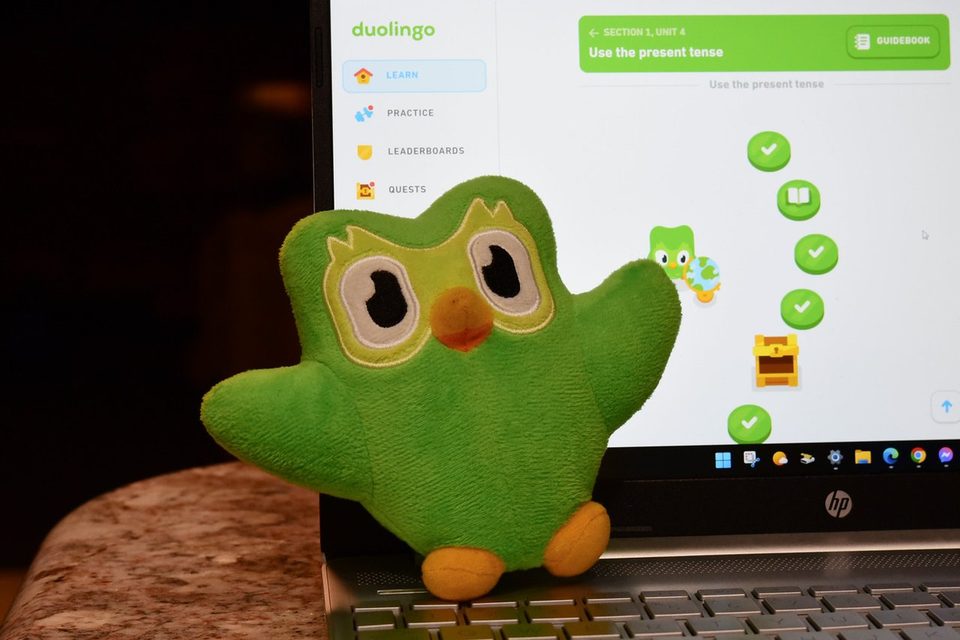
I once watched a man do a Spanish lesson in a hotel elevator in Dallas, at 11:55 on a Tuesday night, phone tilted toward the wall the way people used to tilt cigarettes. Conference lanyard, bad suit, the whole costume. The doors opened on his floor, he didn't move, and the doors closed, and he finished the lesson standing still while the car went back down. I got off on mine. I thought about him for years.
I recognize the behavior now, because I spent five hundred days doing a version of it. Not in elevators. In my kitchen, at 11:52, brightness down so the screen wouldn't wake anyone, completing a lesson I had already completed in every way that matters except the one the app counts.
Because the streak is the argument. A streak is a promise the app wrote, handed to you, and then charges you to keep; the owl is the collections department, and it works nights. The lesson the man in the elevator was finishing had almost nothing to do with Spanish. He was defending a number, and the number was defending the company's daily active user chart.
The streak is a debt the app issues, then prices
The mechanics fit on a coin. Complete one lesson, the day counts. Miss the day, the count resets to zero, unless a Streak Freeze was already in your pocket. Duolingo applies freezes silently, no prompt, because the person who missed a day is by definition the person who isn't opening the app. Free users can hold two, with milestone bonuses pushing long-streak users to five, per the Deconstructor of Fun teardown published in May. The company's own writing on this is refreshingly candid. A post on the streak redesign reports the experiment numbers: separating the streak from the daily goal produced a 3.3 percent increase in fourteen-day retention and, in twenty days, a 10.5 percent increase in daily learners holding streaks. The post ends with the sentence that explains an entire industry, we can't teach people if they stop using Duolingo. Note who wrote it and why. Every figure in it is vendor-run, from a company whose revenue is the behavior being tested. That's not a reason to dismiss the data. It's a reason to notice what they optimize.
Then there's the owl. Duolingo changes its app icon through the day, and the mascot's expression runs from patient to red-eyed as midnight approaches. The home screen widget goes red after ten with a demand to save your streak, and the notifications carry countdowns, hours and minutes left to keep a number alive. It is the most effective guilt interface ever shipped, and I say that with a product manager's admiration and a user's scar tissue. Consider what the guilt is attached to. The free tier shows ads and now meters lessons through an Energy system that recharges in about a day, or refills if you watch a rewarded ad. Super, which removes the ads and the meter and adds a monthly Streak Repair, runs about $13 a month, up to $120 a year at the top of the September 2026 price points. The family plan covers six accounts for roughly $120 to $144. Max, the AI tier, sold for about $30 a month until August, when the CEO said on the earnings call that they may actually sunset it. The prices move. The anxiety doesn't.
Five hundred days bought me a menu, and a ceiling
I want to be fair about what I got. Five hundred days of Spanish left me able to order food, read street signs, follow a slow conversation if the speaker is patient, and produce sentences a native speaker can forgive. That's a real return on a free product. What it did not buy is fluency, and the gap between the streak and the skill is where the interesting dishonesty lives. On the worst nights the lesson was nine multiple-choice taps performed at 11:58 to defend a number rather than to meet a language. The streak measures showing up. It has nothing to say about what happens after you show up, and the app has no incentive to build a feature that tells you the difference.
I've seen this shape before. In my consulting years I watched a client team defend a customer satisfaction score for three straight quarters while the product underneath it got worse, and nobody in the building was lying; the number was just easier to hold than the thing it stood for. That's what a daily visible metric does to a person. It becomes the goal, and the goal it was a proxy for quietly retires. The streak also sells a specific confidence: five hundred days is legible in a way intermediate Spanish is not. You can put the number in a bio. Fluency has no integer. The number lets you look committed without anyone being able to audit the commitment, including you, and I mean that as a description of what I did with mine.
The commitment device is doing real work
Here's the strongest version of the other side, and I find most of it persuasive. Akrasia is real. People fail at things they sincerely want to do, and the honest failure mode of language learning is silence, the app deleted in week three, not some dramatic collapse. Against that, a streak is a commitment device, the same family as Ulysses lashing himself to the mast, and the design is smarter than its critics allow. Duolingo cites a University of Pennsylvania and UCLA study finding that a little slack is more motivating than rigid rules, which is why you get two freezes and not zero. When they tested letting learners protect a weekend, people came back more, not less, and the forgiveness mechanics raised measured activity slightly. Vendor-run again, and consistent with the academic literature, which finds Duolingo among the most thoroughly gamified apps in its category. The guilt works because the goal was mine first. The owl didn't invent my desire to speak Spanish. It industrialized my follow-through. I would not have five hundred days of anything without a machine counting, and I'd rather have the machine than have nothing. The part of this side I can't rebut is uncomfortable for me: a promise you'd keep anyway needs no collector, and a promise you wouldn't keep was never really yours.
It depends on which came first, the practice or the number. If you're already practicing, the streak is scaffolding: take the free tier, ignore the meter, let the number help. If the number has become the practice, you're spending attention to defend a proxy, and the fix isn't the family plan, it's unlearning the number, which is harder than unsubscribing. What I watch from here is whether the streak can keep growing without the guilt getting darker, because the retention math and the kindness are on a collision course that some future A/B test will settle. The man in the elevator was keeping a promise. I never found out who it was to.