Jason LeeClaude Pro
Item 17 of 45
Claude writes the way we all pretended to in meetings
The best prose stylist I ever worked beside read her drafts aloud on the fire escape, always at four in the afternoon, always the same ritual: three floors of stairs, two pages of paper, one red pen. Her sentences came out slower than anyone else's and needed less repair than anyone else's, and the difference, which took me a year to name, was that she killed every sentence she admired. Admiration was her test for deletion, on the theory that the sentences writers fall in love with are usually the ones written for the writer rather than the reader. She was not fast, she was not prolific, and she was not promoted, three facts I have never been able to keep separate in my head. I have been thinking about her fire escape every time Claude produces a paragraph, because the paragraphs arrive polished, and I have gradually worked out what the polish is for.
The turn is this: fluency used to be the expensive part of writing, and Claude Pro, twenty dollars a month, twenty a month since September 2023, which I confirmed against Anthropic's own launch announcement, has made fluency a utility. That is the product and it is a real one. What it has not made is the fire escape. Judgment, the part where you decide which sentence deserves to exist, was never for sale, and the subscription quietly rearranges where the scarce skill sits without saying so.
The fluency is real, and it is not the scarce thing
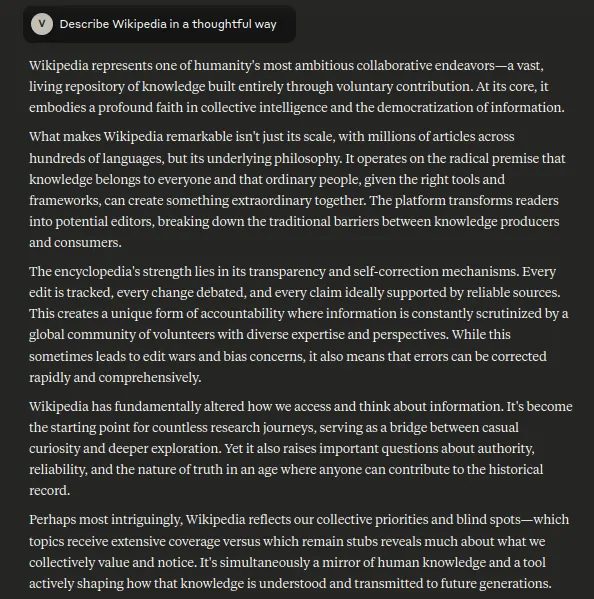
Start with what the twenty dollars actually buys, because the plan has grown less simple than it looks. Pro gets you more usage than free, priority access at peak times, Claude Code, Projects, and the usual 2026 bundle, and if you bill annually the effective rate drops to about seventeen a month at two hundred up front. The model behind it is, on the specific task of drafting English, the best general-purpose writer at retail. Reviewers agree, my own months of use agree, and the agreement is boring at this point. The screenshots write themselves: in the one above, asked to describe Wikipedia thoughtfully, the model produced "the starting point for countless research journeys," a phrase I have banned from my own desk since roughly 2014, when a consultant said it to a client and the client's face did something no deck recovered from. The fluency is real. The fluency is also uniform, which is the part nobody puts in the brochure. Claude's failure mode is not error. It is smoothness, a polished answer to a rough question, and a rough question deserves a rough draft. Which is not the same as a bad one.
The meter, stated plainly, and the audit that follows
The caps deserve plainer treatment than most reviews give them, and to Anthropic's credit the help center is candid: Pro carries a weekly limit across all models, the reset time is assigned to your account whether or not it suits you, and price and plans are subject to change at the company's discretion. Above Pro sit Max 5x and Max 20x, at one hundred and two hundred dollars, tiers that exist because the weekly limit exists. Consider the incentive. Anthropic's revenue lives in the enterprise seats and the API, where Opus-class tokens bill at four dollars in and twenty out per million, and the consumer subscription is a showroom, a place to form the habit at a price so low the habit needs no defense. The safety reputation is inventory too, and it is sold: enterprise buyers pay partly for the brand's carefulness, which is a legitimate purchase and also a purchase. My own incentives are not clean here. I write for a living, I have paid for Pro since the first winter, and every paragraph it drafts is a paragraph I then have to un-polish, labor the subscription prices at zero because the labor is mine. The un-polishing is the fire escape again, which is the part I did not expect to have to keep doing at forty dollars a month for two of these things.
The case for paying, argued better than its marketers argue it
The counterargument almost wins me over, and it gets its own paragraph for exactly that reason. For the person whose bottleneck is drafting, the blank page, the twenty dollars removes the worst hour of the day. A grant writer I know runs her first passes through it and describes the experience as having an intern who never tires of rephrasing; her output went up, her hours went down, and her employer captured both, which she regards as her problem and not mine. The API comparison, which the pricing trackers run honestly, shows light users would pay less per token, but the flat rate is insurance against the invoice that arrives mid-project, and insurance has real value. Against all of that sits one fact I keep circling: the fluency being sold is now the single most abundant commodity the software industry has ever produced, replicated across a dozen products at the same price point, and abundant things have a way of losing their price. What hasn't been replicated is the taste to know which of five fluent paragraphs is lying.
So the verdict lands conditional, and the condition is about you rather than the tool. If your bottleneck is producing drafts, the subscription is worth it, probably at the annual rate, and I'd stop reading essays about it. If your bottleneck is deciding what's true, the polish is a sedative, and the money buys you a faster version of the problem you already had. The fire escape is free. It always was, and it still is the only place I know where a sentence finds out what it's worth.