Jason LeeBuffer
Item 29 of 45
The queue kept posting after the person left
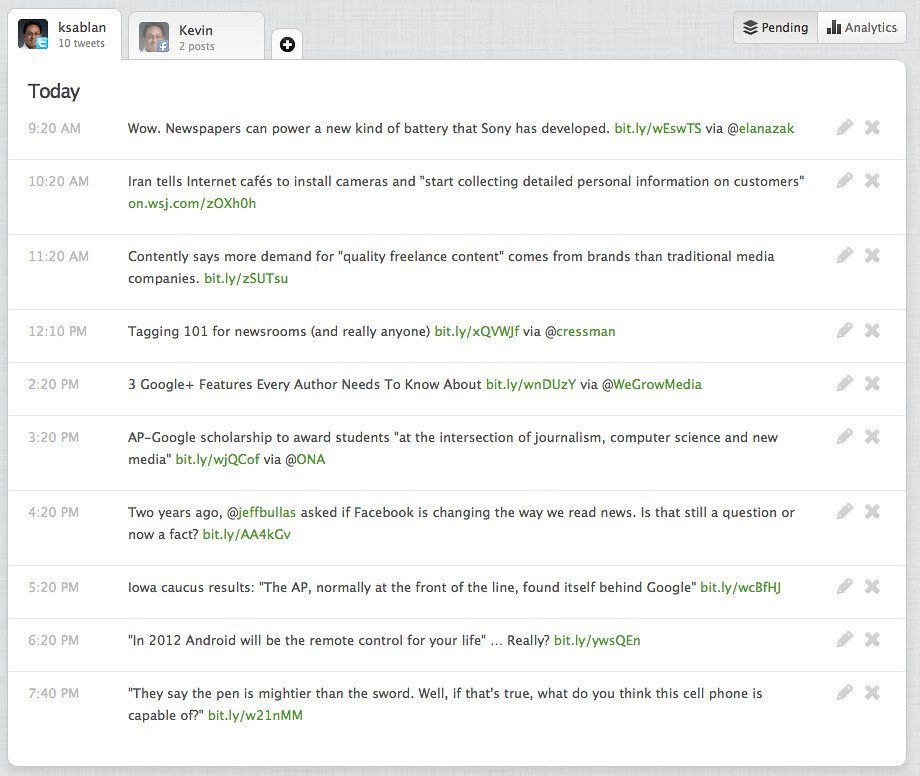
A friend who manages communications at a mid-size company texted me last spring with a screenshot and a question that had no good answer. Her department's social accounts had posted that morning, a cheerful item about a product feature, and the feature had been discontinued in February. The posts weren't wrong exactly, just arriving from a company that no longer existed, because the manager who had queued them had left in January, and the scheduling tool had kept her queue alive out of obedience. Nobody had been told to stop. Nobody, it turned out, had ever been told anything about the queue, because the queue had been one person's judgment, converted into a schedule, and then outlived her. My friend spent an hour hunting through a tool she had never opened, deleting two months of a departed colleague's intentions, one cheerful post at a time.
The tool, she told me afterward, was Buffer. The scene is the argument. Scheduling software exists to bank intent in the present and spend it in the future, and the entire value and the entire risk live in the same mechanism: the future arrives and the tool cannot tell whether the intent is still true. Everything else I want to say about Buffer falls out of that.
The channel is the unit of billing
Buffer is a scheduler, not a strategist, and the pricing states it without embarrassment. A free plan covers three channels and ten queued posts per channel. Essentials runs $6 per channel per month, Team runs $12, annual billing takes about twenty percent off, and volume discounts kick in past ten channels. The usefastlane review, which checked the prices against Buffer's own page on October 1, 2026, put the catch in one sentence: per-channel pricing climbs fast for anyone managing many accounts (the review is here). Run the arithmetic and the structure becomes visible. Ten channels is $60 a month, $720 a year, to operate a switchboard that connects finished posts to ten feeds. Twenty-five channels is the price of a junior employee, and the employee it most resembles is the one who left in the scene above.
Consider the incentive that structure creates. Buffer earns more when you connect more networks, so its product wants you performing on more stages, and the meter is attached to the number of audiences you maintain rather than to anything you produce. That's honest metering of an activity worth metering, and I want to be fair about it. It's also worth noticing that the same structure means Buffer never has to ask whether the posts are any good, whether the channel earns its keep, or whether the whole operation should be smaller. The bill rewards width, and width is the thing every social platform already rewards, which makes Buffer's interests strangely aligned with the feeds' rather than with yours. Most tools in this series sit between you and a customer. This one sits between you and the machine that eats your afternoon.
The queue keeps working after you stop
The mechanism of scheduling is a promise that the present self makes to a future self, and Buffer executes the promise with real competence. The reviews consistently call it the easiest scheduler on the market, and the free plan is genuinely usable rather than a stripped trial. It publishes natively to the networks that allow it, falls back to a phone notification where they don't, and its AI assistant will reword a caption without pretending to write your strategy. What it does not do, and the complaint consensus is unanimous here, is anything after the post lands. Analytics stop at reach and engagement. There's no attribution connecting a post to a signup or a sale, so the reports you build mean exporting the data and doing the thinking elsewhere. Worse, scheduled posts sometimes fail silently, the Instagram integrations in particular get flagged as unreliable, and a silent failure in a system whose entire purpose is to ship things while you sleep is a specific kind of problem: the queue looks full and the wall behind it is empty.
So the tool optimizes for consistency of output, and consistency is a proxy. It's a good proxy; algorithms reward regularity, audiences reward it, and the human cost of manual posting is real. But a proxy is what it stays, and the scene at the top is what a proxy looks like after the thing it proxied has changed. Who benefits if you believe the demo? The networks, who receive your attention labor on schedule; Buffer, whose meter runs on the connection; and your past self, who gets to feel organized at four in the afternoon on a Tuesday. The person harmed is barely a character in the demo. It's the future self, opening the tool in March to find February's judgments still executing.
The case for the queue, made honestly
Now the counterargument, and it's stronger than my friend's story makes it look. The stale queue was a governance failure, not a product failure. Any tool that banks judgment needs an owner of the bank, and the company in that scene had fired its owner and kept the vault. Blaming Buffer for that is like blaming a filing cabinet for unread memos. Second, for a solo creator or a two-person team with a stream of finished work, consistency is nearly the whole game, and the alternative to a scheduler is a person remembering to post, which fails quietly in a way no analytics would catch. Third, the company has spent a decade as this industry's exhibit of decent behavior, publishing its salaries and its own missteps, bootstrapped into profitability rather than riding a growth curve, and that posture shows up in the product as restraint: no engagement-bait feed, no discovery machine pointed at your audience, a calendar that does one job and says so. The complaints about analytics, read carefully, are mostly requests for a different product, and Buffer has never claimed to be that product.
The variable is the number of channels
It depends, and the dependency is whether your problem is shipping or deciding. If you have finished posts and too many platforms, Buffer is the cheapest honest calendar in the category, and the free plan settles the question faster than any review. If you're buying it to fix a content problem or prove a return, it won't, and the per-channel meter will quietly charge you for the width of a strategy nobody owns. Watch one number, and it's not the analytics dashboard: it's the count of connected channels. Every channel you keep connected is a stage you're committed to performing on, and the day you can't name who owns each queue, cancel the channels that have no answer. My friend's screenshot was cheerful, on schedule, and about a product that no longer existed, which is the most complete review of scheduling software anyone has ever sent me.